Tender Preparation Services

A strong tender starts before the writing begins. Tender preparation is the end-to-end work required to understand an opportunity, decide whether to pursue it, interpret the buyer’s requirements, plan the response, gather evidence, develop the submission, check compliance and prepare for lodgement.

Bidsmith helps Australian businesses prepare government, council, corporate and Defence tenders. Our consultants include former government tender assessors, giving us a practical understanding of how submissions are evaluated and what makes evidence easy to find, understand and score.

What is tender preparation?

Tender preparation is the structured process of turning a procurement opportunity into a complete, compliant and competitive submission.

It starts with the tender documents, not the first draft. Effective preparation identifies what the buyer requires, how the response will be evaluated, which requirements are mandatory, what evidence is needed and how your offer should be positioned.

That early work shapes everything that follows. A technically capable business can still submit a weak tender if it starts writing before it has worked out what the evaluator needs to see.

Tender preparation vs tender writing

Tender writing is one important part of tender preparation. Preparation covers the broader process around the written response.

It can include bid/no-bid assessment, analysis of evaluation criteria, compliance planning, response architecture, assigning responsibilities, evidence gathering, win themes, contributor coordination, drafting, review, attachments and lodgement.

Our tender writing services focus on developing and strengthening the written submission. Tender preparation starts earlier and continues through the whole pursuit.
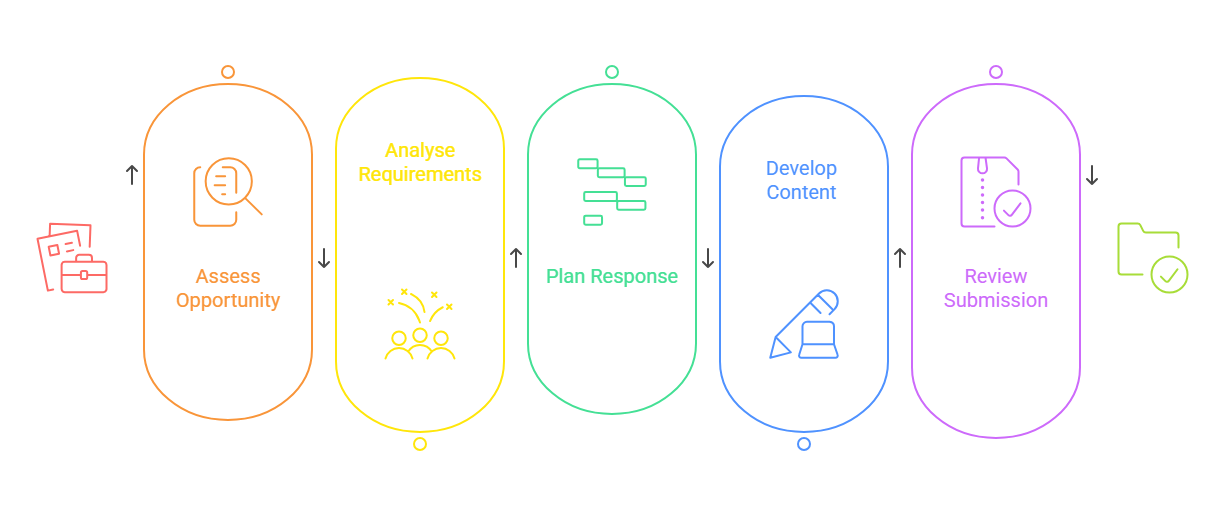
The tender preparation process

A typical tender preparation process moves through six connected stages.

Tender preparation process


1. Assess

Start by deciding whether the opportunity deserves your time and resources. Consider strategic fit, mandatory requirements, contract value, delivery capability, competition, commercial risk, available evidence and the effort needed to prepare a credible response.

A disciplined bid/no-bid decision protects your team from spending valuable time on opportunities you are poorly placed to win or deliver.

2. Analyse

Read the complete request, including schedules, specifications, conditions, attachments, addenda and lodgement instructions.

Identify mandatory requirements and map the evaluation criteria. Work out what each question is really asking and what evidence an evaluator will need to justify a strong score.

Tender preparation should be driven by the evaluation framework. If the response does not address what will be assessed, polished writing will not rescue it.

3. Plan

Set the response structure, responsibilities, milestones, review points and document controls before drafting gains pace.

Decide what messages need to run through the submission, what differentiates your offer, where evidence will come from and which gaps need to be resolved. For complex bids, this is also the stage to coordinate subject matter experts, commercial inputs and executive approvals.

4. Develop

Gather the material that proves your capability, including relevant experience, case studies, methodologies, personnel, systems, certifications, performance data and other supporting evidence.

Then draft each response to the specific question and evaluation criterion. Make the claim, explain how you will deliver, provide evidence and show why it matters to the buyer.

5. Review

Review the tender as an evaluator would. Check whether it answers the questions, supports important claims, communicates the value proposition clearly and remains consistent across multiple sections and contributors.

Complete a separate compliance review covering mandatory requirements, schedules, attachments, page or word limits, signatures, file requirements and other instructions.

6. Submit

Finalise approvals, attachments, filenames and portal requirements before the deadline. Allow time for upload and technical issues rather than treating lodgement as the last administrative task.

A submission that cannot be opened, is incomplete or misses a mandatory instruction can undermine weeks of otherwise strong work.

How to prepare a tender document

If you are preparing a tender internally, begin by creating a clear map of what the purchaser requires.

Read the complete request before drafting. Separate mandatory conditions from scored criteria and administrative instructions. For each response, identify the question, the buyer’s underlying concern, the evidence you can provide and the benefit your approach creates.

Avoid generic company descriptions. Evaluators need to assess your offer against a particular procurement, so explain how your experience, people, systems and methodology apply to this contract.

Support material claims. Instead of saying your service is reliable, show how you manage service continuity and provide relevant performance results, examples or controls where available. Instead of saying your team is experienced, identify the people proposed and demonstrate relevant experience.

Keep terminology, commitments and key messages consistent across the submission. Before lodgement, perform both a content review and a compliance review.

For more detailed guidance, see our tender preparation checklist for businesses and advice on preparing for a tender before the deadline pressure starts.

Tender preparation checklist

Before submitting, confirm that:

  • the opportunity fits your business strategy and delivery capability
  • all mandatory requirements have been identified and can be met
  • each evaluation criterion has a planned response
  • responsibilities, milestones and review points are clear
  • the response structure follows the request and makes assessment easy
  • important claims are supported by relevant evidence
  • case studies demonstrate comparable outcomes
  • personnel, licences, certifications, insurances and policies are current
  • pricing and narrative responses are consistent
  • contributors use consistent messages, terminology and commitments
  • all returnable schedules and attachments are complete
  • the final response has been reviewed for content, compliance and readability
  • required internal approvals and signatures are complete
  • portal, file format, naming and lodgement requirements have been checked
  • submission is planned early enough to manage upload or technical problems.

Common tender preparation mistakes

Many tender weaknesses begin before the writing stage.

Starting too late compresses strategy, evidence gathering and review. Bidding for a poor-fit opportunity can consume resources without a credible path to success. Missing mandatory requirements can make an otherwise persuasive response non-compliant.

Generic responses also create scoring problems. An evaluator can only assess what the submission demonstrates against the stated criteria. Unsupported claims, vague descriptions and recycled content force the evaluator to infer capability rather than giving them clear evidence.

Multiple contributors can create another problem. Without response planning and document control, terminology, commitments and messages can conflict across the submission.

Finally, leaving compliance and lodgement checks until the end introduces avoidable risk.

Our article on common mistakes in the tender management process explores several of these issues in more detail.

Tender preparation in practice

A regional, owner-operated civil works business approached Bidsmith for its first formal government tender. The opportunity suited the business, but it had limited tendering experience, limited supporting documentation and no internal bid management system.

Bidsmith reviewed the tender documents, explained the evaluation criteria, developed the bid strategy, created structured content and supporting material, and managed the response through to final review. The business won the approximately $2 million government construction contract and also gained reusable content and a stronger foundation for future tenders.

The lesson is practical. The client already had delivery capability. Better preparation helped turn that capability into evidence an evaluator could assess.

What evaluators look for in a well-prepared tender

Evaluators need to be able to connect your response to the evaluation criteria and find credible evidence for the score they give you.

From an evaluator’s perspective, a strong response makes three things easy to identify: the answer, the evidence and the benefit to the purchaser.

Clear structure matters because evaluators may be comparing several lengthy submissions against the same criteria. If important evidence sits in an unrelated section, relies on implication or is buried in generic corporate material, it becomes harder to assess.

Evidence also needs to prove the claim being made. A list of previous clients may show experience, but a relevant case study that explains the comparable scope, your role, the challenge, the approach and the result usually gives an evaluator more useful information.

Compliance does not guarantee a strong score. A tender can satisfy the submission rules and still fail to demonstrate why the bidder is the better choice.

Bidsmith’s consultants include former government tender assessors. We use that perspective throughout preparation, not only during the final review.

When professional tender preparation support helps

External support is most useful when the value or importance of the opportunity justifies specialist input, or when your internal team lacks the time, capacity or tender experience to prepare the submission properly.

Consider the complexity of the procurement, the number of contributors, the evaluation requirements, your available evidence, internal workload, deadline, contract value and consequences of losing the opportunity.

Some businesses need end-to-end support. Others need help interpreting the tender, planning the response, developing selected sections or independently reviewing a draft. An experienced consultant should help you choose the level of support that matches the pursuit rather than assume every tender needs the same service.

How Bidsmith supports tender preparation

Bidsmith can support the complete preparation process or selected stages. Depending on the tender, that may include opportunity assessment, bid strategy, tender analysis, response planning, compliance management, stakeholder coordination, evidence development, tender writing, editing, independent review and final submission readiness.

We work across government and corporate procurement and across many industries. You bring the subject matter knowledge. We bring tender strategy, process, writing and evaluator insight.

If you need specialist industry support, see our tender writing services across industries.

Tender preparation for small, growing and enterprise businesses

Different organisations need different levels of preparation support.

Small businesses often need help understanding the request, organising evidence and turning practical delivery experience into a professional submission. See our tender support for small businesses.

Growing businesses may already tender regularly but need stronger strategy, more bid capacity, better reusable content or support pursuing larger contracts. See our tender support for growing businesses.

Enterprise teams often have established bid processes and need targeted strategic advice, specialist resources, independent challenge or additional capacity for a major pursuit. See our enterprise tender strategy and support.

Frequently asked questions about tender preparation

How long does tender preparation take?

The time required depends on the size, complexity and procurement format of the tender, the quality of information already available and the number of people contributing. Starting early gives you more time to assess the opportunity, gather evidence, resolve gaps and review the submission properly.

What are mandatory tender requirements?

Mandatory requirements are conditions that a bidder must satisfy for the submission to proceed through the procurement process. They may relate to licences, insurances, accreditations, forms, declarations, contract conditions, submission format or other specified requirements. Identify them early rather than relying on a final compliance check.

How do evaluation criteria affect tender preparation?

Evaluation criteria tell you what the buyer intends to assess. They should guide response planning, evidence selection, writing effort and review. Where weightings are disclosed, they can also help determine where the submission needs the greatest focus.

What evidence should be included in a tender?

Use evidence that supports the specific claim and is relevant to the requirement. This may include comparable case studies, quantified outcomes, performance data, qualifications, certifications, personnel experience, methodologies, systems, references or examples of successful delivery.

When should we engage a tender consultant?

Consider external support when the opportunity is strategically important, complex, time-sensitive or difficult to resource internally, or when an independent evaluator perspective would strengthen the submission. The earlier a consultant is involved, the more opportunity there is to influence strategy and preparation rather than simply edit a near-final draft.

Talk to an experienced tender consultant

Strong tender preparation gives your business a clearer strategy, stronger evidence, better control of compliance and a submission that is easier for evaluators to assess.

Whether you are preparing your first tender, pursuing larger contracts or adding specialist support to an established bid team, Bidsmith can help at the level that suits the opportunity.

Talk to an experienced consultant today